Private Flood Insurance Acceptance Criteria
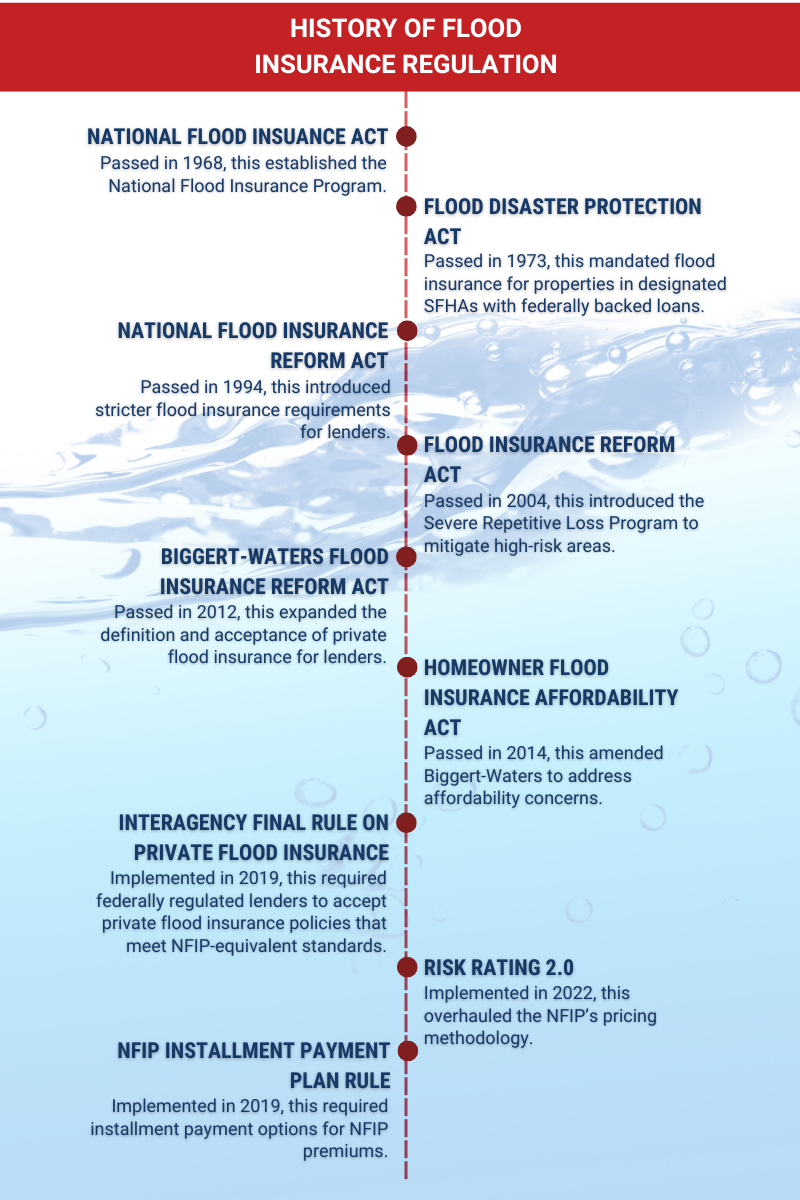
Private flood insurance must meet specific requirements defined under 42 U.S. Code § 4012a, as outlined in the Biggert-Waters Flood Insurance Reform Act of 2012.
If a private policy includes the “Compliance Aid Clause” no further analysis is necessary for the lender to accept the policy. If this clause is not present, lenders must review the proposed policy to ensure it meets all of the following requirements.
Be Issued by an Approved Insurer:
The insurance company must be licensed, admitted, or otherwise approved to operate in the state or jurisdiction where the insured building is located.
Alternatively, for certain policies covering commercial properties (e.g., difference in conditions, multiple peril, or all-risk policies), the insurer must be recognized or not disapproved as a surplus lines insurer in the state or jurisdiction.
Provide Equivalent Coverage:
The policy must offer flood insurance coverage that is at least as broad as the coverage provided by the National Flood Insurance Program (NFIP). This includes comparable deductibles, exclusions, and policy conditions.
Include Key Provisions:
Cancellation/Non-Renewal Notice: Insurers must provide 45 days’ written notice of cancellation or non-renewal to:
- The insured party, and
- The lender (either a regulated lending institution or a federal agency lender).
NFIP Information: The policy must include details about the availability of NFIP flood insurance.
Mortgage Clause: The policy must contain a mortgage interest clause, similar to that in standard NFIP policies.
Legal Action Timeline: The policy must require any legal action (e.g., lawsuits for claim denials) to be filed within 1 year from the date of the written denial.
Restrictive Cancellation Provisions:
Cancellation terms must be as strict as those in NFIP standard flood insurance policies.
This ensures private flood insurance provides borrowers and lenders with protections and coverage equivalent to NFIP policies.
Click on the corresponding grid below to learn more about the forms and notices used for flood insurance.
Standard Flood Hazard Determination Form (SFDHF)
The SFHDF is a critical tool for managing flood risk in real estate transactions and protecting lenders, borrowers, and properties from the financial impacts of flooding.
Mandated by the National Flood Insurance Act of 1968, this form is used by lenders to determine whether a property is located in a Special Flood Hazard Area (SFHA).
Download the Standard Flood Hazard Determination Form
Sample Borrower Notice of Option to Escrow
The Option to Escrow Notice helps borrowers understand their rights and options for managing flood insurance payments, while ensuring lenders comply with federal flood insurance regulations. Under the Biggert-Waters Flood Insurance Reform Act of 2012 and subsequent regulations, this notice is required to inform borrowers of their right to escrow flood insurance premiums and fees.
Lenders must provide this notice when a loan secured by a building or mobile home is made, increased, extended, or renewed and:
- The property is located in a SFHA.
- Flood insurance is required as a condition of the loan.
Sample Borrower Notice of Non SFHA Location
While not federally required, lenders often issue a notice informing property owners that a structure is not located in a Special Flood Hazard Area (SFHA) to:
- Ensure transparency and build trust with borrowers.
- Confirm flood risk assessment results.
- Document communication in case of disputes or errors.
This is used if a flood zone determination indicates that the property is in a moderate or low-risk flood zone.
Download Sample Notice
Sample Borrower Notice of Special Flood Hazards
The Borrower Notice of Special Flood Hazards is required when a loan is secured by property in a Special Flood Hazard Area (SFHA), including loans originated, purchased, or serviced by federally regulated institutions or backed by federal agencies. This notice must be provided when a lender originates, increases, extends, or renews a loan secured by a building or mobile home located within an SFHA.
Borrowers must be notified even if the community does not participate in the NFIP, with lenders explaining the flood risk, coverage implications, and potential private insurance options. While flood insurance may be unavailable through the NFIP due to non-participation, lenders are still required to notify the borrower of the flood risk and explain the implications and they may assist the borrower in identifying private flood insurance options.
Download Sample SFHA Notice Download Sample Not Participating NoticeThe NFIP Community Status Book is an essential tool for understanding a community’s relationship with the NFIP and ensuring compliance with flood insurance and risk management regulations. It is widely used by lenders, insurers, policymakers, and property owners to make informed decisions regarding flood insurance and development in flood-prone areas.
Maintained by the Federal Emergency Management Agency (FEMA), the NFIP Community Status Book provides detailed information about communities participating in the National Flood Insurance Program (NFIP). It serves as a reference for understanding the status of communities in relation to the NFIP, including whether they are active participants, suspended, or ineligible.
FEMA provides the book as a free online resource on its website. It is organized by state for easy access.